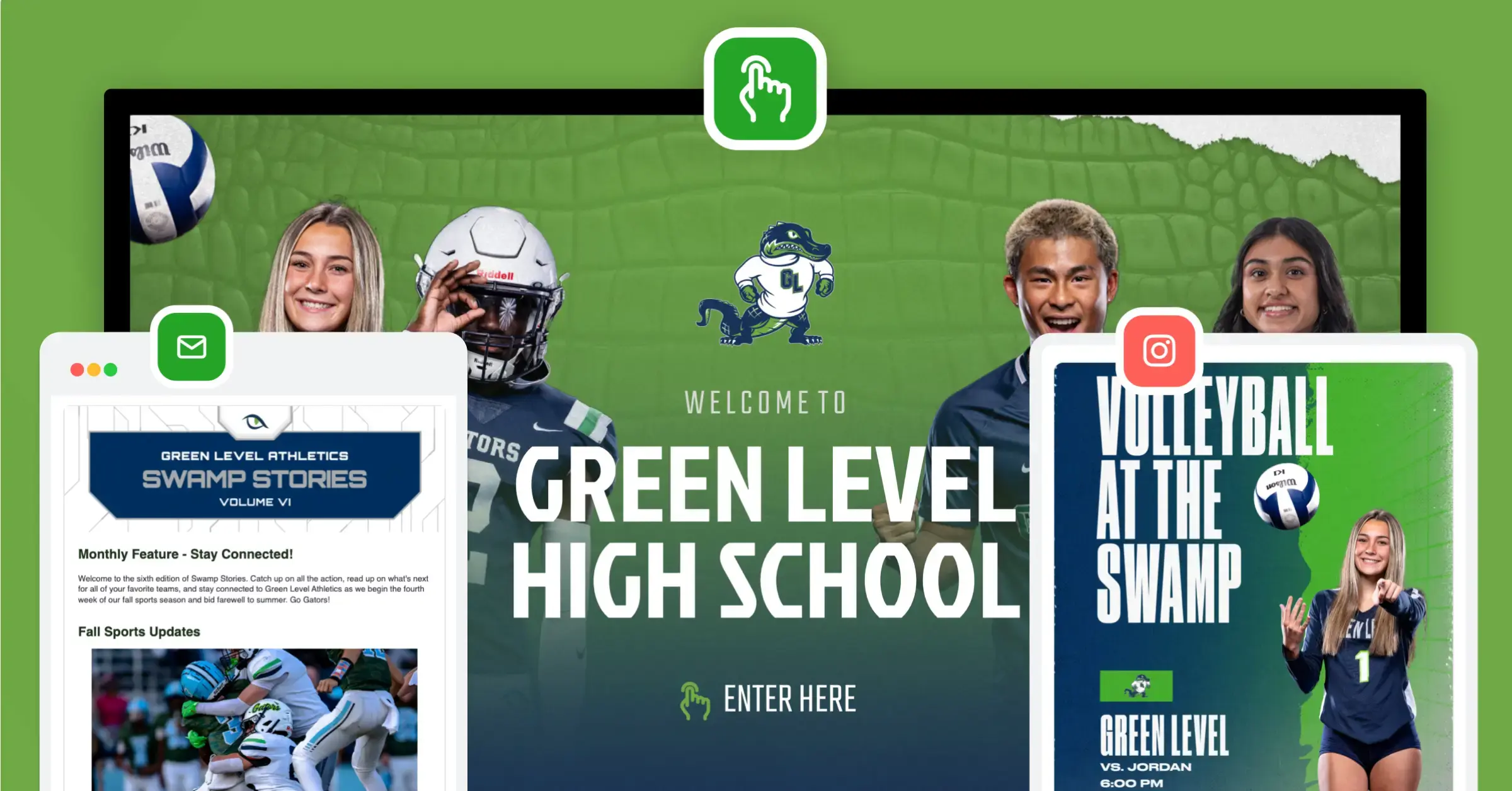

Green Level High School opened its doors in Cary, North Carolina, in 2019 with no traditions, no alumni base, and no athletic history. Five years later, the program's social media accounts generate over 450,000 impressions every month. Their monthly newsletter reaches thousands of families. Visitors walking through the building encounter a facility experience that rivals Division I programs. And the athletic director behind it all — Colin Fegeley — was named North Carolina Athletic Director of the Year.
None of that happened by accident. Green Level's athletic department branding wasn't a side project or an afterthought. It was an intentional, strategic decision made from day one. And the framework behind it — three pillars that any AD can adopt — is something you can start replicating at your school this week.
The Vision: A Division I Experience at the High School Level
When Colin Fegeley took the AD role at Green Level, he had something most athletic directors never get: a completely blank slate. No inherited systems to work around. No "we've always done it this way" culture to navigate. Just an empty building and a decision to make about what this program would stand for.
Colin made a deliberate choice. He decided to build Green Level's athletic program the way a Division I university builds its brand — with professional-quality visuals, consistent messaging, and an experience that communicates excellence before anyone steps onto a field or court.
The philosophy behind that decision is worth pausing on: the quality of your brand signals something important about the quality of your program. When a prospective family tours Green Level and sees polished graphics, dynamic digital displays, and a cohesive visual identity across every sport, they draw a conclusion. They assume the coaching is serious, the facilities are well-maintained, and the culture is intentional. That's not superficial — that's strategic.
Colin understood that athletic department branding isn't about logos and color schemes. It's about how your program is perceived by every audience that matters: students, parents, staff, community members, local media, and future student-athletes. And he built a system to control that perception across three distinct channels.
Watch: Why Every Athletic Director is Now a Marketer
Pillar 1: Social Media and Digital Storytelling
The first pillar — and the one that produced the most visible results the fastest — was social media. But Green Level didn't just "start posting." They committed to a high school sports brand strategy rooted in two non-negotiables: consistency and quality.
Every post from Green Level athletics features professional-level graphics with consistent branding. Scores, highlights, athlete spotlights, schedule announcements — all of it looks like it came from a collegiate sports information department. The fonts match. The colors match. The templates match. Whether it's varsity football or JV tennis, the visual standard is the same.
The results speak for themselves.
In year one, Green Level's athletics social media accounts generated over 1 million impressions. Today, the program sustains 450,000+ impressions per month with 50,000 profile visits monthly.
Those aren't vanity metrics. That's real attention from real people — parents, students, community members, and prospective families — engaging with the program's story on a daily basis.
Here's what that looks like in practice:
Parents share game-day graphics on their own social feeds, extending the program's reach without any additional effort from the AD's office. Students follow teams beyond their own sport because the content is worth following. Local media outlets pull graphics and information directly from the athletic department's accounts because the quality is broadcast-ready.
The key insight from Green Level's athletic program social media strategy is this: consistency plus quality equals a signal of excellence.
When you post professional content on a reliable schedule, you're telling your community that this program is organized, that it values every athlete equally, and that it takes pride in representing the school. That message compounds over time.
You don't need a graphic design degree to execute this. Tools like Gipper give you access to professionally designed, school-branded templates that make it possible to post high-quality content in minutes — which is exactly what Green Level uses to maintain their output across 20+ sports programs.
Pillar 2: Direct Community Communication (Swamp Stories)
Social media is powerful, but it has a limitation: you don't control the algorithm. A post you spend twenty minutes creating might reach 10% of your followers — or it might reach 80%. You can't predict it, and you can't guarantee it.
That's why Colin built a second pillar: a monthly school athletics newsletter called Swamp Stories (named after Green Level's Gator mascot). This newsletter goes directly to families, staff, and community members — no algorithm, no filtering, no guessing who saw it.
Swamp Stories covers everything happening across the athletic department: team highlights, upcoming events, student-athlete features, facility updates, booster club news, and a personal message from the AD. It's not a game recap. It's a narrative — a curated story about the state of the program, told on the AD's terms.
Why does this matter? Because narrative control is one of the most undervalued assets in high school athletic department marketing. Social media lets you participate in the conversation. A newsletter lets you set the conversation. You decide what the community knows about your program, what stories get told, and how the overall trajectory is framed.
Most athletic departments don't have a newsletter. It's not because they don't see the value — it's because they assume it requires too much time or too many resources. But a simple version is easier to start than you think. A monthly email covering five sections — AD message, team highlights, upcoming events, athlete spotlight, and a community callout — takes about an hour to assemble once you have a template in place. Gipper's communication tools can streamline this process further, giving you branded templates and distribution in one platform.
The ADs who build this channel now will have a direct line to their community that no social media algorithm change can take away. That's a competitive advantage worth the hour per month.
Pillar 3: The On-Campus Experience
The third pillar is where the brand comes to life in three dimensions. Green Level's facilities don't just house athletic programs — they showcase them.
Walk into the building and you'll see a 75-inch Gipper Touch digital display in a high-traffic area, cycling through athlete recognition, team schedules, live social media feeds, and hall of fame content. TVs throughout the athletic facilities display branded content — scores, upcoming events, motivational graphics, and student-athlete spotlights. Wall graphics reinforce the visual identity with the same design language used across social media and the newsletter.
This is what Colin means when he talks about a "Division I feel." When a student walks past a dynamic display showing last night's scores alongside a feature on a teammate who just signed a letter of intent, it communicates something powerful: this program sees you, this program celebrates you, and this program is serious about what it's building.
That message isn't just for current students. When a prospective family tours the school, the on-campus experience is often the first impression they form of the athletic department. A static trophy case from 2008 tells one story. A dynamic digital display showing this season's achievements, updated in real time, tells a very different one.
The on-campus experience also reinforces the other two pillars. Content created for social media gets a second life on the digital displays. Newsletter stories are visualized on the screens. The brand becomes omnipresent — and that omnipresence is what transforms a program from something people are vaguely aware of into something they feel connected to.
The Multiplier Effect: How the Three Pillars Compound
Each of Green Level's three pillars is valuable on its own. But the real power of this athletic department branding framework is what happens when they work together.
Social media builds awareness. The newsletter deepens the relationship. The on-campus experience makes the brand tangible. A parent sees a game-day graphic on Instagram, reads about the team's season in Swamp Stories, and then walks into the school for a conference and sees the same story playing on the digital display in the lobby. That's not three separate touchpoints — that's a single, cohesive brand experience across three channels.
When visibility compounds like this, something shifts. Your program goes from invisible to institutional. The community isn't just aware of Green Level athletics — they're invested in it. Booster club participation grows. Event attendance increases. Student-athletes feel recognized and valued. Parents become advocates who recruit other families to the school.
Green Level didn't build this overnight. But they built it intentionally, one pillar at a time. And the compounding effect means that the program's brand today is exponentially stronger than the sum of its individual parts.
How to Replicate This at Your School
You don't need to be a brand-new school to build what Green Level has built. You don't need a clean slate, a massive budget, or a full-time marketing staff. You need a framework and the willingness to start. Here's how to approach it:
1. Start with the first pillar: social media
This has the lowest barrier to entry and the fastest visible impact. Commit to posting consistently with branded, professional-quality graphics for every sport. You don't need to post ten times a day. Three to five posts per week, using consistent templates, is enough to start building momentum. Gipper's social media tools let you create school-branded graphics in minutes, which is how programs like Green Level maintain output across dozens of teams without burning out.
2. Add the second pillar: a newsletter
Once your social media rhythm is established (give it 30–60 days), launch a simple monthly newsletter. Start with five sections: a note from you, team highlights, upcoming events, an athlete spotlight, and a community callout. Use an email platform you're comfortable with, or explore Gipper's built-in communication features to keep everything in one place.
3. Build the third pillar over time: the on-campus experience
This is the pillar that typically requires the most investment, but it doesn't have to happen all at once. Start with a single digital display in a high-traffic area — a lobby, a gym entrance, or an athletic office hallway. Populate it with the content you're already creating for social media and the newsletter. Gipper Touch was built specifically for this purpose, giving you a digital hub for recognition, schedules, social feeds, and hall of fame content.
The key is starting. Colin Fegeley didn't wait until everything was perfect to launch Green Level's brand. He started with what he had, committed to consistency, and built from there. Five years later, the results are undeniable. Your timeline will look different, but the framework is the same.

Athletic department branding frequently asked questions
How did Green Level High School build such a strong athletics brand?
Green Level built its athletics brand using a deliberate three-pillar strategy: consistent, professional-quality social media content; a monthly newsletter called Swamp Stories that gives the athletic department direct narrative control; and an on-campus digital experience featuring dynamic displays and branded facility graphics. AD Colin Fegeley treated the program like a collegiate brand from day one, and the consistency across all three channels created a compounding effect that drives over 450,000 social impressions per month.
What are the three pillars of a successful athletic department brand?
The three pillars are social media and digital storytelling, direct community communication (such as a monthly newsletter), and the on-campus brand experience (including digital signage and facility branding). Each pillar serves a different function — social media builds awareness, the newsletter deepens relationships, and the on-campus experience makes the brand tangible — but together they create a cohesive program identity that compounds over time.
How do I start a newsletter for my athletic program?
Start simple with a monthly email that covers five sections: a personal message from the AD, team highlights from the past month, upcoming events and schedules, a student-athlete spotlight, and a community or booster club callout. Use a free email platform or a tool like Gipper that includes built-in communication templates. The first edition doesn't need to be perfect — consistency matters more than polish. Budget about one hour per month once you have your template set.
What should an athletic program post on social media?
Post a mix of game-day graphics (scores, highlights, and matchup announcements), student-athlete spotlights, schedule updates, behind-the-scenes content, and program milestones. The most important factors are consistency (three to five posts per week minimum) and visual quality (branded templates that match across every sport). Programs like Green Level use Gipper to create professional graphics quickly, which makes it possible to cover 20+ sports without overwhelming the AD's office.
How long does it take to build a strong athletic program brand?
Green Level generated over 1 million social media impressions in its first year, which shows that meaningful traction is possible quickly when you commit to consistency and quality. Most programs can establish a recognizable social media presence within 60–90 days of consistent posting. A newsletter builds its audience over three to six months. The on-campus experience can develop over one to three years as budget allows. The compounding effect means each month of effort makes the next month more impactful.
Related articles
.webp)
.png)